
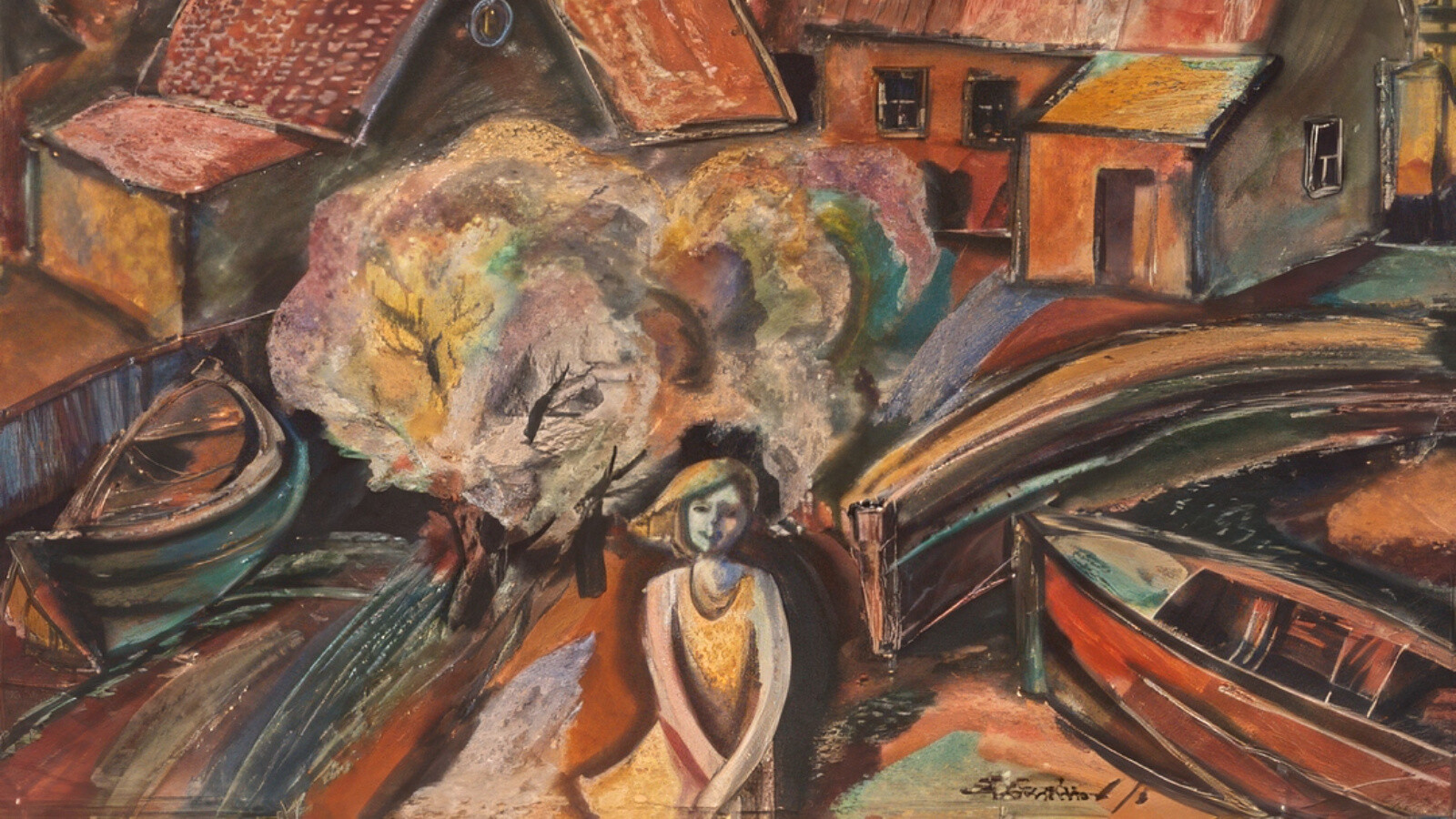
On December 24 at 4:00 PM, the exhibition “The Path of Cognition” by Zufar Gayanov will open at the Khazine National Art Gallery of the State Museum of Fine Arts of the Republic of Tatarstan.
Zufar Gayanovich Gayanov (1941–2015) was a book artist, People’s Artist of the Republic of Bashkortostan (2003), and a member of the Union of Artists of the RSFSR (1975). The exhibition is dedicated to the 140th anniversary of the birth of Gabdulla Tukay. Its central focus is a series of works on silk created based on the motifs of the classic Tatar writer’s literary works. The exhibition features early works from the 1970s—landscapes and still lifes executed in watercolor and etching techniques—alongside figurative and thematic works inspired by ancient Chinese gohua painting.
Zufar Gayanov was born in 1941 in the village of Seityakovo, Baltachevsky District of the Bashkir ASSR. He received professional training at the Moscow State Academy of Art Education and the Ufa State Institute of Arts. From 1969 he lived and worked in Ufa. Beginning in 1972, he collaborated with the Bashkir Book Publishing House. From 1981 to 1987, he served as Director of the M. V. Nesterov Bashkir State Art Museum. From 1996 to 2013, he taught at the Faculty of Painting of the Ufa State Academy of Arts (now the Zagir Ismagilov Ufa State Institute of Arts). His works are held in museums and art galleries across Russia, in private collections, and abroad (Germany, France, Turkey, Bulgaria, China, and the USA).
Zufar Gayanov’s art is multifaceted in both character and style, closely connected to—and fully dependent on—the techniques and genres he chose. Over more than 50 years, his artistic path developed consistently: from academic graphics and painting to mastering Eastern techniques; from genre separation to a free synthesis of landscape, allegory, meditative imagery, and historical-mythological narrative.
One of the most important features of his works is luminosity. In Gayanov’s art, light does not imitate real illumination but emerges from within the painting itself through the interaction of color, texture, and symbolism. Special attention is drawn to his use of intentional ambiguity. The artist deliberately leaves open, unfilled areas in his compositions (in keeping with the Chinese tradition of liu bai—“reserved whiteness”), inviting viewers to engage in their own interpretation.
An analysis of the key cycles of Zufar Gayanov’s work reveals three leading motifs.
First, there is a reinterpretation of myth: in the “Ural-Batyr” cycle, the hero is presented not as a ruler of nature, but as its creation—his figure emerges from rocks, clouds, fire, and water. This reflects the worldview of Turkic peoples, in which humans are understood as an organic part of nature and the cosmos rather than the center of the universe.
Second, Gayanov develops the concept of time as memory: in works connected with personal and cultural history, the past and present coexist not sequentially, but simultaneously, layering upon one another.
Third, for the artist, technique itself carries meaning. Having mastered Chinese gohua painting, he does not imitate its external features but deeply absorbs its aesthetic principles—the value of emptiness as a space for reflection, and conciseness as a form of concentrated meaning. At the same time, he fills this technique with Bashkir imagery and philosophy, creating a unique hybrid artistic language.
The exhibition will be open to visitors from December 25 to January 18, 2026, on the second floor of the Khazine National Art Gallery of the State Museum of Fine Arts of the Republic of Tatarstan (Kazan Kremlin, Sheinkmana St., 12, Entrance 3).
Source: mincult.tatarstan.ru


